%20(1).png)

Governed AI: Turning Automation into Accountable Action

Most organizations are not exploring AI because they want less accountability. They are exploring AI because they want to move faster, reduce friction, improve service, reduce manual work, and make better use of the knowledge already moving through the business.
Those are good goals. But AI on its own does not create better customer experiences. Automation can accelerate a process, but it cannot decide whether that process is fair, explainable, accurate, or trustworthy.
Governance does that work.
That is where AI adoption often gets complicated. A team experiments with an AI assistant. A process owner automates part of a workflow. A service team uses AI to summarize customer interactions. Marketing tests AI-generated content. Operations looks for ways to speed up decisions. Each use case may make sense on its own, but customers do not experience isolated use cases. They experience the journey.
And when AI influences that journey across teams, systems, content, decisions, and handoffs, accountability can become blurry. Organizations do not struggle because they lack AI. They struggle because they lack governance around how AI is used, validated, monitored, and owned. Governed AI turns automation into accountable action.
The customer experiences the journey, not your AI use case
A customer trying to open an account, submit an application, renew a policy, register for a program, resolve an issue, or access a service does not know where AI is being used behind the scenes. They do not see the model, the workflow, the approval path, or the internal handoff.
They only know whether the experience feels clear, fair, useful, and trustworthy.
AI can improve that experience when it helps people find information faster, reduces repetition, supports employees, and removes unnecessary friction. But AI can also create new frustration when it gives the wrong answer, hides the reason behind a decision, sends the customer down the wrong path, or makes a process feel less human at the exact moment trust matters most.

This is where governance matters. It connects AI activity to customer outcomes, business risk, human review, and decision accountability. Without it, automation can scale faster than an organization’s ability to explain, validate, or own the impact.
AI governance matters because customer trust is built in the handoffs
AI risk is rarely limited to one tool or one team. More often, it appears in the spaces between systems and decisions, where a recommendation becomes an action, an insight becomes a message, or a generated response shapes what a customer does next.
Marketing uses AI to draft campaign content, but no one verifies whether the message aligns with the actual customer promise.
A service team uses AI to summarize customer interactions, but important context is lost before the next employee picks up the case.
A workflow automates eligibility guidance, but the organization has not defined who is accountable when the guidance is wrong.
An internal AI tool improves speed, but employees do not know when they are expected to review, override, or escalate.
A chatbot answers common questions, but the customer has no clear path to a human when the answer does not fit their situation.
None of these examples start with someone deciding accountability does not matter. They happen because AI is introduced into a journey without enough clarity around ownership, escalation, review, and decision rights.
That is the danger of treating AI governance as a policy exercise instead of an operating model. Everyone agrees responsible AI matters. Everyone assumes the right checks are happening. But if no one owns the decision path, the first real test may happen when a customer is misdirected, delayed, excluded, or given an answer the organization cannot explain.
Governance cannot be fully automated
It is tempting to believe that AI governance can be solved with another layer of automation: automated policy checks, automated monitoring, automated approvals, automated documentation. These tools can help, but they cannot replace judgment.
Governance requires people to decide what should be automated, what should remain human-led, what level of risk is acceptable, what customer impact needs review, and who is accountable when an AI-supported decision affects someone’s experience.
The stronger CX question is not only, “Can we automate this?” It is, “Should we automate this, how will we know it is working, and who owns the outcome if it does not?”

The cost of automation without accountability
When organizations rely on automation without governance, the cost does not stay neatly inside the technology team. It shows up in operations, support, customer confidence, employee decision-making, failed audits, fines, and lawsuits.
Customers lose confidence when AI-supported answers are inconsistent, unclear, or difficult to challenge.
Employees absorb the risk when they are expected to use AI but are not given clear guidance on review, escalation, or override.
Support teams carry the fallout when automation creates confusion that has to be corrected manually.
Business decisions become harder to defend when no one can explain how an AI-supported recommendation was made or approved.
Trust is weakened because customers experience the organization as efficient, but not necessarily accountable.
From a customer experience strategy perspective, this is the real issue. AI governance is not just about whether an organization can point to a policy or prove it reviewed a tool. It is about whether AI-supported work helps customers, employees, and citizens move through a journey with clarity, confidence, and trust.
AI cannot govern itself. It needs people who understand the business outcome, the customer impact, the knowledge being used, the decisions being influenced, and the points where human review or escalation is required.
Ownership means designing the journey, not just deploying the tool
Owning AI governance does not mean one person controls every AI use case. That is not realistic, and it is not how modern customer experiences are built. It means the organization has clear accountability for how AI is introduced, validated, monitored, improved, and escalated across the journey.
A CX-led view of AI governance asks different questions:
Where does the customer, citizen, or employee begin?
What decisions do they need to make or understand?
Where does AI influence information, recommendations, content, routing, or decisions?
What knowledge sources does AI rely on, and who is responsible for keeping that knowledge accurate?
Where is human review required before an AI-supported action reaches the customer?
What exceptions need escalation instead of automation?
Who is accountable when an AI-supported outcome is wrong, incomplete, unclear, or difficult to explain?
What policies, standard or regulations apply at each of these touchpoints and handoffs?
How are the policies communicated to the AI and the to the people involved in the process?
How is the evidence of compliance captured and stored?
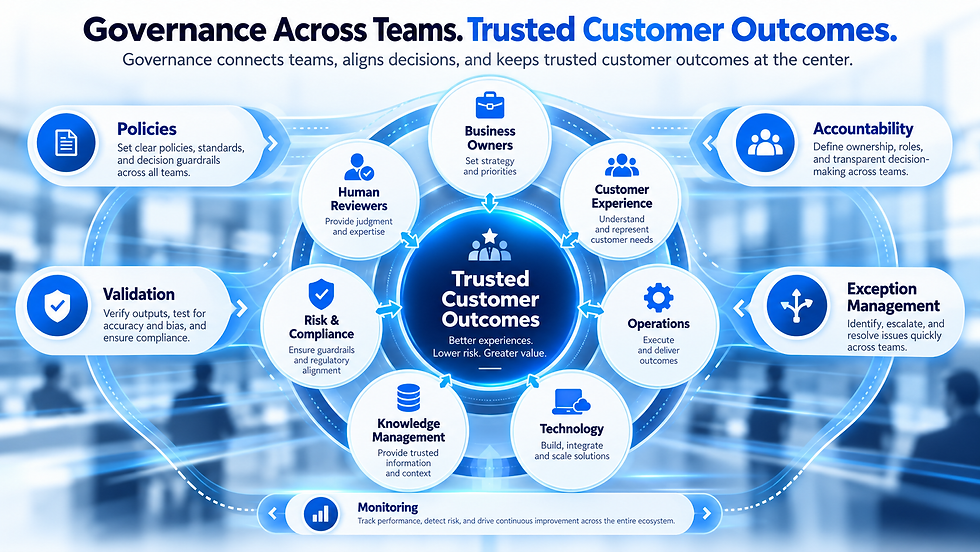
The shift is subtle, but it changes the work. Instead of asking each team to “use AI responsibly” in isolation, the organization asks, “Can we trust the outcome this AI-supported journey creates?” That is a very different measure of success.
AI governance has to move upstream
Too often, governance is introduced after the AI use case is already in motion. A team tests a tool. A workflow gets automated. Content is generated. A chatbot goes live. A knowledge base is connected. Only later does the organization ask who owns the output, how it will be reviewed, what happens when it is wrong, and how risk will be monitored over time.
Moving AI governance upstream means making it part of how customer journeys are planned, funded, designed, procured, built, tested, launched, and maintained. It means asking governance questions before a tool is selected, before a workflow is automated, before knowledge is connected, before a model-supported recommendation is used, and before a customer-facing experience goes live.
It also means recognizing that AI governance is never “done.” Journeys change. Content changes. Policies change. Knowledge changes. Customer expectations change. If no one owns how AI is validated, monitored, and improved over time, today’s useful automation can become tomorrow’s risk point.
This is why mature organizations establish AI governance as an operating model. Governance creates the policies, ownership, review processes, exception paths, validation checkpoints, knowledge controls, and accountability needed to make AI trustworthy as experiences evolve. Without governance, AI depends on individual judgment and one-off effort. With governance, responsible AI becomes part of how the organization operates.
What accountability looks like in practice
For organizations that want AI to support better customer experiences, accountability has to be practical. It cannot live only in policy language, technical documentation, or annual risk reviews. It has to show up in the way work gets planned, assigned, reviewed, monitored, and improved.
Name an owner for the end-to-end AI-supported journey. This person does not need to do every task, but they need authority to coordinate across teams and escalate risk.
Map where AI influences the customer experience. Include web, chatbot, portal, form, email, document, support, internal workflow, and decision touchpoints.
Define responsibilities by role. Make it clear what business owners, CX teams, operations, technology, knowledge management, risk and compliance, and human reviewers are each responsible for.
Build governance into intake and approval processes. AI use cases should include purpose, data and knowledge sources, review requirements, exception handling, risk level, and decision ownership before launch.
Validate the outcome, not just the tool. Review whether the AI-supported process produces accurate, useful, explainable, and trustworthy results for the people relying on it.
Track exceptions like customer experience issues. Hallucinations, inaccurate answer.
The real measure is whether the outcome can be trusted
That is why this topic is the focus of our October webinar and why our theme for the month is Governed AI: Turning Automation into Accountable Action. AI cannot keep sitting in the organization as a collection of experiments, pilots, and disconnected tools. If organizations want AI to improve customer journeys and business outcomes, they need to understand where AI is being used, what knowledge it relies on, how outputs are validated, when human review is required, and who owns the decision when something goes wrong.

Join the webinar to explore how governance workflows, human oversight, knowledge governance, validation, review, exception handling, audit use cases, and AI guardrails help organizations move from AI experimentation to responsible operational adoption. Then continue the work by downloading the AI Governance Framework, completing the AI Governance Maturity Asse
ssment, and downloading the Executive Guide to AI Governance. Because governed AI turns automation into accountable action.
s, unclear recommendations, missing escalation paths, and weak knowledge sources should be visible, assigned, measured, and resolved.


