%20(1).png)
Digital Accessibility Requirements
for Manitoba
This page summarizes Manitoba’s key accessibility requirements that may apply to organizations delivering digital services in the province, with an emphasis on digital accessibility (websites, applications, documents, and online services). It is intended to help teams understand what to consider during design, development, procurement, and ongoing operations.
Note: This content is provided for general information only and does not constitute legal advice. If you need a formal interpretation of requirements for your organization, consult qualified legal counsel and your compliance team.

At a glance
-
Applies to: Manitoba organizations covered by The Accessibility for Manitobans Act (AMA)—including government, public sector bodies, and private/non-profit organizations with employees in Manitoba (with requirements phased in by organization type).
-
Digital accessibility baseline: Manitoba’s Accessible Information and Communication Standard Regulation requires newly published web content (and web content required to access goods and services) to meet WCAG 2.1 Level AA, at minimum; and requires new or significantly updated web applications to meet WCAG 2.1 Level AA, at minimum. In practice, this is most relevant when you publish new content or make significant updates to web applications, not only when you launch a brand-new site.
-
Common risk areas: online forms, PDFs, and transactional services—especially where users must complete steps independently.
-
Ongoing obligation: accessibility is not a one-time project; changes to content, templates, and workflows can introduce new barriers.
Executive brief:
Accessibility requirements in Manitoba
-
Organizations operating in Manitoba may be required to meet defined digital accessibility requirements under the AMA and its standards.
-
Online forms, PDFs, and digital services are among the most common sources of accessibility barriers and non-compliance risk.
-
Accessibility gaps create legal, service-delivery, and reputational risk—particularly for public-facing services.
-
Accessibility obligations are ongoing and apply as digital services evolve.
-
Early assessment and prioritization help reduce long-term remediation cost and exposure.
Who this applies to
These requirements can apply to a range of organizations operating in Manitoba, including:
-
Manitoba government ministries and agencies
-
Municipal governments and service providers
-
Regional health authorities and other public-sector bodies
-
Educational institutions and libraries
-
Private and non-profit organizations with employees in Manitoba
Digital content and services commonly in scope include:
-
Public websites and web applications (including key user journeys and templates)
-
Online forms and transactional services (apply/register/submit/payment flows)
-
PDFs and other digital documents published to the public (or provided as part of service delivery)
-
Portals, authenticated areas, and third-party components you control (directly or contractually)
Scope notes: Applicability and compliance dates vary by organization type under the AMA’s standards. “Digital” should be read broadly to include web content, forms, documents, and the end-to-end process a user must complete—not only individual pages. If people rely on your digital services to apply, register, submit requests, or access programs, digital accessibility requirements are likely in scope.
Key laws, regulations, and standards
Manitoba accessibility requirements are driven by provincial legislation, associated regulations (“standards”), and recognized accessibility standards. In practice, obligations focus on whether people can independently access information and complete digital services—and whether accessible alternatives and accommodations are available when barriers exist.
Key accessibility drivers in Manitoba include:
The Accessibility for Manitobans Act (AMA) (2013)
Manitoba’s core accessibility law. It establishes a framework for enforceable accessibility standards (regulations) to prevent and remove barriers.
Accessible Information and Communication Standard Regulation (enacted 2022)
The standard most directly tied to digital delivery. It includes requirements to: notify the public and employees that accessible formats/communication supports are available on request; respond to requests by consulting with the requester and providing the information in a timely manner at no extra cost; establish a feedback process; and train specified individuals on accessible information and communication (including Manitoba’s Human Rights Code).
Web Content Accessibility Guidelines (WCAG)
The internationally recognized technical standard used as Manitoba’s measurable baseline for websites, web content, and web applications. Under Manitoba’s Accessible Information and Communication Standard Regulation, newly published web content (and web content required to access goods and services) must meet WCAG 2.1 Level AA at minimum, and new or significantly updated web applications must meet WCAG 2.1 Level AA at minimum. Some limited exceptions apply, as set out in the regulation.
The Human Rights Code (Manitoba) (duty to accommodate)
Creates ongoing obligations to prevent discrimination and accommodate disability-related needs in services, employment, and facilities. Where barriers exist, organizations may need to provide accessible alternatives or individualized accommodations (up to undue hardship).
What compliance looks like for digital products and websites
Manitoba requirements are not only about meeting a technical standard—they also depend on repeatable delivery practices that prevent barriers from reappearing as services evolve. For digital teams, a strong accessibility program combines measurable conformance targets (like WCAG 2.1 Level AA) with ongoing design, build, testing, content, and support processes.
-
Define the bar and scope: set your target (commonly WCAG 2.1 Level AA) and what’s included (templates, documents, forms, key journeys, web apps).
-
Operationalize accessibility: build it into design, development, content, QA, and procurement so it remains consistent over time.
-
Prove and sustain: test, keep evidence, remediate issues, and re-test to reduce regression risk—especially after releases and content updates.
What Organizations Commonly Get Wrong
-
PDF forms that cannot be read by screen readers
-
Online forms missing labels, instructions, or error guidance
-
Keyboard navigation failures in application workflows
-
Legacy portals still used for essential public services
-
Accessibility treated as a one-time project instead of an ongoing responsibility
Many organizations meet accessibility requirements in parts but struggle to maintain consistency across services—especially when new content is published without accessibility checks.
What accessible digital service delivery looks like
Accessible digital services are:
-
Navigable without a mouse or touch input
-
Clear, readable, and understandable for all users
-
Designed to prevent errors and reduce confusion
Well-designed accessible forms and services improve usability for everyone, not just users with disabilities.
In practice, accessibility improvements often reduce support calls, processing time, and back-office rework.
Regulatory Timeline & Risk Map
Accessibility timeline in Manitoba (Accessible Information & Communication Standard Regulation)
-
May 1, 2023: Provincial government organizations must comply with the Accessible Information and Communication Standard Regulation (including WCAG 2.1 AA requirements for newly published web content and for new/significantly updated web applications).
-
May 1, 2024: Regional health authorities, cities, educational institutions, and libraries must comply.
-
May 1, 2025: Private and non-profit organizations with employees in Manitoba (and small municipalities) must comply.
-
Ongoing expectation: Accessibility obligations are not limited to new projects; services should remain accessible over time, and updates can introduce new barriers if accessibility is not governed.
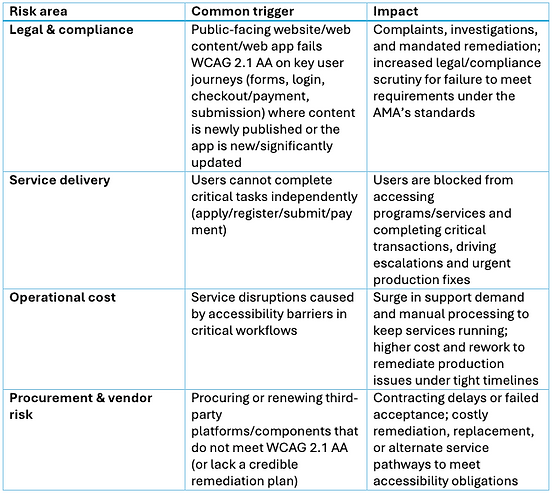
Manitoba Accessibility Risk Map
Risk most often surfaces where forms, applications, and transactional services are the primary way people access services.
These issues typically surface first in high-volume or legacy services where forms and documents are central to service delivery.
Implementation checklist
Plan
-
Define scope (domains, apps, documents, third‑party tools) and target conformance level.
-
Identify owners (product, design, engineering, content, QA) and escalation paths.
-
Ensure procurement includes accessibility requirements and acceptance criteria.
Design & build
-
Use accessible color contrast, typography, and focus states.
-
Ensure all functionality works with keyboard only (no mouse required).
-
Use semantic structure (headings, lists) and proper form labels and instructions.
-
Provide text alternatives for non‑text content (images, icons, charts).
Test & release
-
Run automated accessibility checks on key templates and flows.
-
Complete manual checks: keyboard navigation, focus order, visible focus, and error handling.
-
Perform screen reader spot checks for critical journeys.
-
Document known issues and a remediation plan before launch.
Operate & improve
-
Monitor and triage accessibility feedback and track resolution time.
-
Re-test periodically (especially after major releases and design-system updates).
-
Keep accessibility documentation current (standards, patterns, checklists, training).
Common deliverables and evidence
-
Accessibility statement (public): what you support, known limitations, how to contact you for help, and how to request accessible formats.
-
Conformance report: a structured summary of WCAG conformance and exceptions (often requested in procurement).
-
Test results: audit reports, automated scan outputs, and issue trackers showing remediation progress.
-
Remediation plan: prioritization rationale, target dates, and release plan for fixing known accessibility issues.
-
Procurement-ready acceptance criteria: accessibility requirements written into user stories/SOWs, plus how exceptions will be documented and approved.
-
Training records: evidence that required staff/roles have completed accessible information and communication training.

How 4Point can help
4Point works with organizations to interpret accessibility obligations and implement practical improvements across PDFs, online forms, and public‑facing digital services. Whether you’re confirming what standards apply in your jurisdiction or updating legacy content that blocks users, we help you prioritize work, reduce risk, and improve access through a clear, step‑by‑step approach.
Accessibility requirements can be hard to navigate—but getting clear on what applies to your organization is the first step to meeting them with confidence.
Accessibility requirements can be hard to navigate—but getting clear on what applies to your organization is the first step to meeting them with confidence.
Start with an accessibility audit. If you’re unsure where you stand against Manitoba’s accessibility requirements and WCAG, 4Point can run a practical audit to establish a baseline, identify the highest-risk barriers, and give you a prioritized remediation roadmap.
-
Scoping session: confirm which forms are in scope, the number to be reviewed, and the accessibility standard(s) to assess against.
-
Forms accessibility audit: review an agreed number of forms and document accessibility gaps.
-
Conformance report and prioritization: provide conformance findings, severity ratings, and a recommended fix order.
-
Recommendations and remediation plan: share recommendations for addressing identified gaps and provide a statement of work for remediation of the audited forms (remediation is not included in the audit engagement).
Next step: request an audit by sharing your digital scope (properties, platforms, documents), your target standard (e.g., WCAG 2.1 AA), and any upcoming procurement or reporting deadlines. We’ll confirm the audit approach, sample size (templates/journeys), and deliver a prioritized findings summary with recommended fixes.