%20(1).png)
Understanding California
Government Code §7405
Information and Communication Technology (ICT) Accessibility & Procurement Requirements
California Government Code § 7405 is the primary procurement and technical governance law for electronic and information technology (EIT) across California state government. While civil rights statutes like Government Code § 11135 and the Unruh Act focus on non-discrimination outcomes, § 7405 focuses directly on the technology itself.
The significance of § 7405 lies in its direct mandate: state entities must align with federal Section 508 of the Rehabilitation Act standards when developing, procuring, maintaining, or using digital technologies.
For public sector agencies and the technology vendors that serve them, § 7405 elevates accessibility from a post-launch design preference to a mandatory procurement gatekeeper throughout the software delivery lifecycle.
Note: This content is provided for general information only and does not constitute legal advice. If you need a formal interpretation of requirements for your organization, consult qualified legal counsel and your compliance team.

California Government Code §7405 at a Glance
-
Section 508 Alignment: Directs California state governmental entities to comply with federal Section 508 accessibility standards.
-
Shift to Upstream Procurement: Requires technology to be evaluated for accessibility before purchase contracts are signed or software is deployed.
-
Broad System Scope: Applies to public-facing websites, internal employee enterprise systems, custom applications, and commercial off-the-shelf (COTS) software.
-
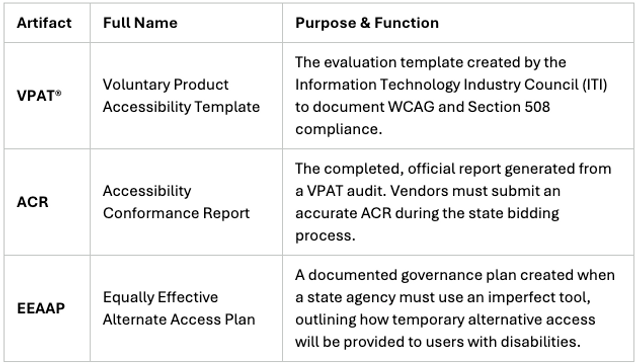
Mandatory Vendor Artifacts: Vendors bidding on state contracts must supply an Accessibility Conformance Report (ACR).
-
Equally Effective Alternate Access Plans (EEAAP): Mandates documented fallback accommodations when non-compliant products are temporarily permitted.
Scope and Coverage:
What Technology Is Covered?
Government Code § 7405 applies broadly to electronic and information technology across all California state departments, boards, commissions, and public institutions. Covered technology falls into five primary operational categories:
-
Public Portals & Web Applications: Citizen-facing websites, payment gateways, self-service portals, and downloadable mobile apps.
-
Internal Enterprise Systems: Employee intranets, HR software, ERP platforms, and internal databases used by state workers to perform essential job functions.
-
Cloud Platforms & SaaS: Third-party cloud software, software-as-a-service platforms, and external vendor tools procured by state agencies.
-
Digital Content & Media: Downloadable PDFs, electronic forms, web-based spreadsheets, multimedia, and public-facing video content.
-
Hardware & Self-Service Kiosks: Physical IT hardware, public touchscreen kiosks, and office equipment used in government facilities.
The Procurement Gatekeeper: VPAT, ACR,
and EEAAP
The most critical operational feature of Government Code § 7405 is its impact on state procurement. State entities cannot legally purchase software or IT services that fail accessibility standards without formal exception documentation.
Key Procurement Artifacts Required Under § 7405:
Embedding Accessibility Throughout the System Lifecycle
Addressing accessibility after software has been deployed is costly and inefficient. Section 7405 encourages state agencies and contractors to integrate testing and verification throughout the entire project lifecycle:
1.Planning & RFP Creation
Pre-Procurement
Define explicit WCAG 2.1 / 2.2 Level AA and Section 508 requirements in Request for Proposals (RFPs) and vendor contracts.
2.Vendor ACR Evaluation
Selection Phase
Analyze submitted Accessibility Conformance Reports (ACRs) and validate vendor claims through independent, third-party audit sampling.
3.Development & Testing
Implementation
Perform continuous automated and manual assistive technology testing (screen readers, keyboard-only controls) during sprint cycles.
4.EEAAP & Deployment
Final Acceptance
Draft an Equally Effective Alternate Access Plan for any unresolved minor issues before approving production release or final payment.
What This Means for Vendors Doing Business in California
If your organization builds, licenses, or sells technology products to California state agencies, Government Code § 7405 directly shapes your sales cycles:
-
Inaccurate ACRs Cause Contract Disqualification: Submitting a generic or inaccurate VPAT/ACR can result in immediate RFP rejection or contract termination.
-
Contractual Indemnification: State buyers increasingly require vendors to fix identified accessibility defects at the vendor’s expense during the contract period.
-
Competitive Advantage: Vendors offering verified, fully accessible products with transparent ACR documentation enjoy a major advantage in state bidding.
Intersecting California Frameworks
Government Code § 7405 provides the technical foundation for California's wider digital accessibility framework:
-
Section 508 of the Rehabilitation Act: Provides the federal standard incorporated directly into state law under § 7405.
-
AB 434 (Government Code § 11546.7): Requires state agency leadership to certify that public websites meet the standards enforced by § 7405.
-
State Administrative Manual (SAM) Section 4833: Details administrative IT accessibility policies across California state entities.
-
WCAG 2.1 / 2.2 Level AA: Serves as the technical benchmark for evaluating code compliance.
Key Takeaway
California Government Code § 7405 shifts accessibility from a reactive code fix to a proactive technology governance and procurement requirement. By aligning state procurement with Section 508 standards, § 7405 ensures that software, systems, and digital assets purchased or built by the state are accessible from day one.

How 4Point can help
Start with an accessibility audit. If you’re unsure where you stand against federal expectations and WCAG, 4Point can run a practical audit to establish a baseline, identify the highest-risk barriers, and give you a prioritized remediation roadmap.
-
Scoping session: 4Point will confirm which forms are in scope, the number to be reviewed, and the accessibility standard(s) to assess against.
-
Forms accessibility audit: 4Point will review an agreed number of forms and document accessibility gaps.
-
Conformance report and prioritization: 4Point will provide conformance findings, severity ratings, and a recommended fix order.
-
Recommendations and remediation plan: 4Point will share recommendations for addressing identified gaps and provide a statement of work for remediation of the audited forms (remediation is not included in the audit engagement).
Next step: request an audit by sharing your digital scope (properties, platforms, documents), your target standard (e.g., WCAG 2.1 AA), and any upcoming procurement or reporting deadlines. We’ll confirm the audit approach, sample size (templates/journeys), and deliver a prioritized findings summary with recommended fixes.